
#RecycleRight
We use plastic almost every day, but we still do not really understand it, even though there is a huge amount of information concerning plastic pollution, as well as ideas and tactics for minimizing plastic use, available on the Internet. Even though we are aware that plastics contain dangerous chemical pollutants that contribute to global warming, they have become an inextricable part of our daily life. While plastic has many useful applications, it is rapidly destroying our planet.
Unlike biodegradable materials like paper, wood, rubber, and wool, which can be absorbed into the soil and recycled naturally, plastic takes hundreds of years to break down organically. This means that plastic waste will continue to accumulate and end up in landfills or the environment. As a society, we must acknowledge that plastic pollution is not only a concern for the environment, but also for our economic, health, social, and moral well-being, as well as that of future generations.
Just because we do not see waste building up on the streets does not mean we do not have a waste problem or that we should be less responsible when it comes to waste reduction. We have unwittingly adopted a “disposable” lifestyle and consumed far more plastic than is necessary.
In my final year capstone project, I want to study the current situation of recycling in Singapore among the millennial (aged between 25 – 40 years old) so that I could explore the opportunity to encourage more millennial to increase their engagement in recycling practices.
Service
Campaign, App,
Year
2021

The Problem/Opportunity Statement
Based on a recent study, Singapore uses around 1.76 billion plastic products each year, the majority of which cannot be recycled, resulting in plastic trash that will have an environmental impact even if properly disposed of. According to the existing research, though Singaporeans have become more aware of environmental issues, recycling is not widely practiced as their comprehension of recycling is still superficial.
Despite increasing efforts to raise public awareness about the importance of recycling and reusing plastic products, Singapore has low recycling rates. Singapore’s domestic recycling rate dropped from 22% in 2018 to 17% in 2019, falling behind the European Union, which reported a rate of 46.4% in 2017. In contrast, the non-domestic recycling rate, which includes business and industrial sectors in Singapore, has a recycling rate of 68% in 2019. Furthermore, other countries in Asia such as Taiwan has a domestic recycling rate of 55% in 2020 and have a high plastic recycling rate of 73%.
Our plastic consumption is also high. Each person used at least 1 to 3 plastic bottles per week and 13 plastic bags per day in Singapore. Due to the pandemic, additional single-use plastic waste is accumulating in our offshore landfill and negatively impacting our natural ecosystem.
Drawing from other countries’ experience, it is evident that increasing domestic recycling rates is a difficult task that does not occur overnight. It will take a long time to make recycling a habit at home. We need to change our people’s mindset and cultivate a stronger recycling culture. Plastic waste is reduced when we use less of it. It is undoubtedly we can achieve greater efficiency and sustainability because recycling is easy in Singapore.
We need to find a solution to empower millennial, currently between 25 and 40 years old, to play a more productive role in recycling behaviors as they will be the most powerful consumers to determine the future of our environment.

Do you still remember that there is a period that your Facebook is flooded with an image of a sea turtle with a straw stuck inside its nostrils?

While working on this project, I realized how little we know about our actions, which have a significant impact on the place that YOU & I will spend the rest of our life.


Research Purpose
-
Identify plastic recycling behaviour
-
Explore potential factors that may influence them to be less proactive in recycling.
-
Learn about millennial’ current attitudes toward recycling,
-
Evaluate their recycling knowledge
-
Identify challenges they faced when recycling.


This study requires a deeper understanding of human behaviours and their attitudes toward recycling.
I used semi-structured interview to collect data that allows me to focus on important aspects and capture the interviewees’ behavior, attitudes, and preference.


Recycling attitudes and behaviors are the result of a diverse combination of various factors, and the proposed design solutions must aim to account for all of factors.


Concept
#recycleRight is a mobile app that aims to promote plastic recycling, inspire more people to start recycling, and educate people how to properly dispose of waste. The goal is to empower millennials with knowledge through effective communication platform, allowing them to combat pollution and protect our families, communities, and environment.

Low-fi Prototype: Testing + Findings
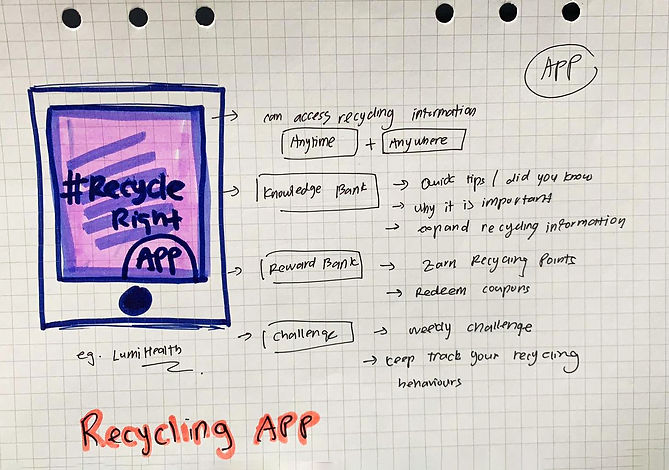
In the early stages of the development process, I sketched out basic representations of the initial concept. The aim of the sketches are to simply lay out the flow and explore into potential capabilities before I proceed in creating a clickable prototype for user testing.

User Flow
I used a flowchart diagram to map out the many processes involved in providing the user in achieving a meaningful goal when using this mobile app. It gave me a general idea of how users engage with a design, as well as the quantity of decision points they face along the way to reaching a specific goal. There were three key stages in the flow chart: an entry point, steps to completion, and the final step in completing a goal or final interaction.

I built clickable prototypes in Adobe XD that allow me to test user flows, visual element placement, visual hierarchy, and interactivity. It also enabled me to switch from a low-fidelity to a high-fidelity prototype without having to switch prototyping tools. Each screen is designed as clickable wireframes with simple line illustrations or a simple shape to indicate the graphic’s placement. Each frame is filled with dummy content rather than intricate details.
I invited participants of the study to explore the prototype during this initial testing, and I encouraged them to provide honest feedback based on functionality rather than design.
Below are the questions asked to validate my concept:
-
How do you feel about this recycling mobile app?
-
What problem does this mobile app can solve?
-
What features are missing in this initial version of the app?
-
Do you think this mobile app will help you in improving your recycling knowledge, and if so, why?
The participants’ feedback are gathered to determine the desirability, viability, and feasibility of the project.
High-fi Prototype: Testing + Findings
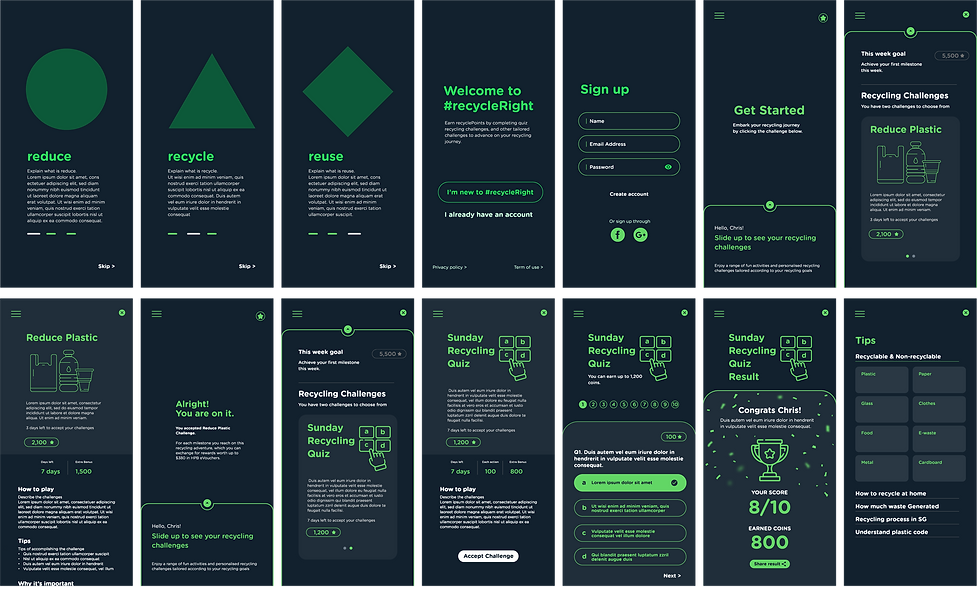
At this stage, I developed an fully-clickable prototype that is as close to the final design as possible, including UI components, colours, layouts, information hierarchy, user experience (UX) elements, and other interactions such as button hovers, navigation schema from a screen to another and all transitions between different objects or screens. I used actual or similar-to-real content in this prototype. It contains the majority (if not all) of the content that will be used in the final design.
The participants are informed that it is a still a prototype and that some areas are not functional. It is not intended to be taken as a finished piece. They are encouraged to suggest design and function flaws. Refer to Figure 9 for the high-fi prototype shown to the participants to test usability and identify issues in the workflow.
Below are the questions asked to validate my design direction and proposed functionality:
-
Do you think the app design matches its purpose?
-
When you explore the app, do you get confused at any point?
-
How likely, or unlikely will you be recommended this app to your friend?
-
How would you describe this app using their own words?
The participants’ feedback are gathered to further determine the choice of design elements, usefulness and functionality of the project.
Design Direction
As #recycleRight is an app about the environment, I used beige and green as primary colours, with purple as a vivid secondary colour, and used it against dark grey background to create a strong contrast. The aim of the design is to make the topic of recycling more lively, fun, and inspiring. To makes the topic more trendy, engaging, and relevant to the target audience, I combined real-life photos with colourful graphics. Below are the some visual representation.


Together,
we can make
a change
Final Prototype : #RecycleRight App


